 Help & Contact
 Track order












Enrofloxacin for Birds: Baytril, Strengths, Uses & Product Guide
Enrofloxacin for Birds: Baytril, Strengths, Uses & Product Guide
When bird owners search for an antibiotic for respiratory or bacterial disease, one name appears repeatedly:
Enrofloxacin.
Another name appears just as frequently:
Baytril.
These are closely connected.
Baytril is a well-known veterinary brand associated with the active ingredient:
enrofloxacin.
Enrofloxacin belongs to the fluoroquinolone family of veterinary antibacterial drugs.
In avian care, it may be considered when a bird has an appropriately identified bacterial infection caused by organisms susceptible to enrofloxacin.
Bird owners commonly encounter enrofloxacin products when researching problems such as:
- Respiratory bacterial infections
- Selected gastrointestinal bacterial infections
- Systemic bacterial disease
- Septicemia
- Selected skin or wound infections
- Bacterial disease in pigeons
But knowing the ingredient name is only the beginning.
A product labeled:
Baytril 2.5%
is not the same concentration as:
Baytril 10%.
And an:
Enrofloxacin 10% Powder
is a different dosage form from an:
Enrofloxacin 10% Oral Solution.
The professional way to compare these products is by looking at:
- Active ingredient
- Strength
- Concentration
- Dosage form
- Bottle or package size
- Individual bird and disease being treated
This guide explains those differences clearly.
Enrofloxacin for Birds: Quick Answer
Enrofloxacin is a fluoroquinolone antibacterial used in veterinary medicine for susceptible bacterial infections.
Baytril is a familiar brand name associated with enrofloxacin.
BirdAntibiotic.com currently carries several enrofloxacin formats, including:
- Baytril 2.5% Oral Solution — 25 mg/mL — 25 mL
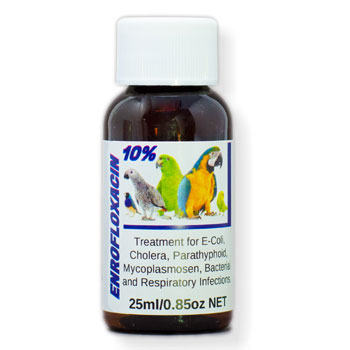
- Baytril 10% Oral Solution — 100 mg/mL — 25 mL
- Enrofloxacin 10% Oral Solution — 100 mg/mL — 100 mL
- Enrofloxacin 10% Oral Solution — 100 mg/mL — 1000 mL
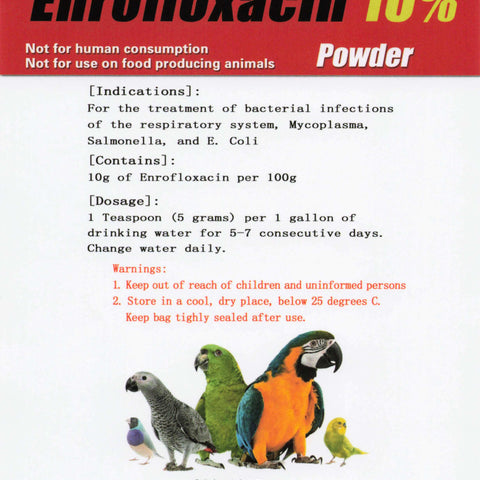
- Enrofloxacin 10% Powder — 100 g
- Enrofloxacin tablet products
Important: 10% liquid enrofloxacin contains 100 mg/mL, while 2.5% liquid contains 25 mg/mL. The 10% liquid is therefore four times as concentrated as the 2.5% liquid, so the same liquid volume cannot automatically be substituted between them.
Explore Bird Antibiotics
Browse our Best Bird Antibiotics collection and explore bird care products organized in one convenient place.
EXPLORE PRODUCTS →What Is Enrofloxacin?
Enrofloxacin is a veterinary antibacterial belonging to the:
fluoroquinolone class.
Fluoroquinolones interfere with bacterial enzymes involved in:
- DNA replication
- DNA repair
- Cell reproduction
When the bacterial organism is susceptible, this can stop the infection from continuing to multiply normally.
Is Baytril the Same as Enrofloxacin?
Baytril is a familiar veterinary brand associated with enrofloxacin.
This means searches for:
- Baytril for birds
- Enrofloxacin for birds
- Baytril for pigeons
- Bird enrofloxacin
are usually referring to the same active antibacterial ingredient.
However:
the concentration and product format can still be completely different.
Why Strength Matters More Than the Brand Name Alone
Imagine two bottles.
Both say:
Enrofloxacin.
But one contains:
25 mg/mL.
The other contains:
100 mg/mL.
They contain the same active ingredient.
They do not contain the same amount of active ingredient in each milliliter.
Explore Bird Antibiotics
Browse our Best Bird Antibiotics collection and explore bird care products organized in one convenient place.
EXPLORE PRODUCTS →Baytril 2.5% vs Baytril 10%
| Feature | Baytril 2.5% | Baytril 10% |
|---|---|---|
| Active ingredient | Enrofloxacin | Enrofloxacin |
| Strength | 2.5% | 10% |
| Liquid concentration | 25 mg/mL | 100 mg/mL |
| Relative concentration | 1× | 4× |
| Current BirdAntibiotic Baytril bottle | 25 mL | 25 mL |
Why 10% Is Four Times as Concentrated as 2.5%
The comparison is straightforward:
Baytril 2.5% = 25 mg enrofloxacin per mL.
Baytril 10% = 100 mg enrofloxacin per mL.
100 divided by 25 equals:
4.
Therefore:
10% liquid enrofloxacin is four times as concentrated as 2.5% liquid enrofloxacin.
Do Not Swap Liquid Volumes Between 2.5% and 10%
The same number of milliliters from the two bottles would deliver very different amounts of enrofloxacin.
Always identify the concentration before measuring any veterinary liquid.
Never assume that a volume intended for a 2.5% product automatically applies to a 10% product.

What Is Enrofloxacin Used for in Birds?
Enrofloxacin is an antibacterial.
Its appropriate use depends on whether the bird actually has a:
susceptible bacterial infection.
In avian veterinary medicine, enrofloxacin may be considered in selected cases involving bacterial disease affecting systems such as:
- Respiratory tract
- Gastrointestinal tract
- Skin and soft tissues
- Systemic circulation
Enrofloxacin for Bird Respiratory Infections
Respiratory disease is one of the most common reasons bird owners search for Baytril or enrofloxacin.
Possible respiratory signs include:
- Repeated sneezing
- Wet nostrils
- Nasal discharge
- Eye discharge
- Wheezing
- Clicking
- Voice changes
- Tail bobbing
- Open-mouth breathing
Respiratory Signs Do Not Automatically Mean Bacteria
Similar symptoms can also occur with:
- Fungal disease
- Viruses
- Respiratory parasites
- Air-sac mites
- Environmental irritants
- Smoke or fumes
- Nutritional disease
This is why identifying the disease category matters before selecting an antibiotic.
Enrofloxacin and Gram-Negative Bacterial Disease
Enrofloxacin is particularly well known for activity against many susceptible gram-negative organisms.
Bird owners frequently encounter it when researching bacteria such as:
- Escherichia coli
- Salmonella
- Pseudomonas
- Other susceptible gram-negative bacteria
Susceptibility varies between organisms and strains.
Enrofloxacin and Gram-Positive Bacteria
Enrofloxacin can also have activity against selected susceptible gram-positive organisms.
But:
“broad spectrum” does not mean “works against every bacterium.”
Bacterial culture and susceptibility testing can be particularly valuable when:
- Infection is severe
- Disease keeps returning
- Previous treatment failed
- A valuable breeding or companion bird is affected
Enrofloxacin and Mycoplasma
Mycoplasma organisms can be associated with respiratory disease in birds.
Enrofloxacin may be considered in selected susceptible cases.
However, simply detecting Mycoplasma or seeing respiratory symptoms does not automatically establish it as the cause of illness.
Explore Bird Antibiotics
Browse our Best Bird Antibiotics collection and explore bird care products organized in one convenient place.
EXPLORE PRODUCTS →Enrofloxacin for Pigeons
Pigeon keepers commonly search for enrofloxacin when birds develop:
- Respiratory signs
- Wet eyes
- Nasal discharge
- Reduced racing performance
- General bacterial illness
But pigeon respiratory disease is a syndrome rather than one diagnosis.
Possible causes include:
- Bacteria
- Chlamydial disease
- Mycoplasma-associated disease
- Viruses
- Fungi
- Environmental irritation
Matching treatment to the actual problem remains important.
Enrofloxacin for Parrots
Parrots can develop bacterial infections affecting:
- Respiratory system
- Digestive system
- Skin
- Wounds
- Other organs
Species, body weight, hydration status, clinical condition and bacterial susceptibility all matter when a veterinary professional selects an antibacterial.
Enrofloxacin for Budgies
Budgies are small birds.
This makes accurate concentration identification particularly important.
A budgie with:
- Sneezing
- Tail bobbing
- Fluffing
- Appetite loss
may have bacterial disease—but can also have:
- Airway irritation
- Fungal disease
- Other respiratory illness
Enrofloxacin for Cockatiels
Cockatiels may show respiratory disease through:
- Repeated sneezing
- Nasal discharge
- Reduced vocalization
- Tail bobbing
- Open-mouth breathing
A diagnosis should guide whether enrofloxacin or another treatment category is appropriate.
Enrofloxacin for Canaries and Finches
Small passerines require careful diagnostic consideration because respiratory symptoms can have very different causes.
For example:
air-sac mites are parasites.
Enrofloxacin does not kill mites.
A canary with respiratory clicking therefore should not automatically receive an antibacterial simply because it is breathing abnormally.
What Enrofloxacin Does NOT Treat
This section is extremely important.
Enrofloxacin is an antibacterial.
It does not directly treat:
- Viruses
- Fungal infections
- Yeast infections
- Mites
- Air-sac mites
- Intestinal worms
- Coccidia
- Trichomonas canker
Enrofloxacin Does Not Treat Every Respiratory Problem
A bird with breathing difficulty may need:
- Antibacterial care
- Antifungal care
- Antiparasitic care
- Environmental correction
- Emergency respiratory support
depending on the actual cause.
Baytril 2.5% Oral Solution for Birds
Baytril 2.5% Oral Solution is one of the current BirdAntibiotic.com enrofloxacin products.
Product details:
- Active ingredient: Enrofloxacin
- Strength: 2.5%
- Concentration: 25 mg/mL
- Form: Oral liquid
- Net content: 25 mL
Shop Baytril 2.5% Oral Solution
Enrofloxacin 25 mg/mL in a 25 mL oral liquid format for pet-bird and companion-animal veterinary care.
Baytril 10% Oral Solution for Birds
Baytril 10% Oral Solution provides a substantially more concentrated liquid formulation.
Product details:
- Active ingredient: Enrofloxacin
- Strength: 10%
- Concentration: 100 mg/mL
- Form: Oral liquid
- Net content: 25 mL
Shop Baytril 10% Oral Solution
Concentrated enrofloxacin 100 mg/mL supplied in a 25 mL liquid presentation.
Enrofloxacin 10% Oral Solution — 100 mL
Enrofloxacin 10% Oral Solution — 100 mL contains the same clearly identified liquid concentration:
100 mg/mL.
Its larger bottle changes the:
total product volume.
It does not change the concentration.
25 mL vs 100 mL Enrofloxacin 10%
If both products contain:
100 mg/mL
then each milliliter contains the same amount of active ingredient.
The difference is simply:
how much total liquid is supplied.
Enrofloxacin 10% — 100 mL
A larger 100 mL liquid format containing enrofloxacin 100 mg/mL.
Enrofloxacin 10% Oral Solution — 1000 mL / 1 Liter
Enrofloxacin 10% Oral Solution — 1000 mL provides:
- Enrofloxacin
- 10% strength
- 100 mg/mL concentration
- 1000 mL / 1 liter total volume
The 1-liter bottle contains ten times as much total liquid as a 100 mL bottle.
But:
the concentration remains 100 mg/mL.
Package Size Is Not Strength
This distinction is essential.
Compare:
- 25 mL
- 100 mL
- 1000 mL
Those numbers tell you:
how much liquid is in the bottle.
They do not tell you:
how concentrated the medication is.
Enrofloxacin 10% Powder for Birds
Enrofloxacin 10% Powder for Pet Birds is currently available in a:
100 g resealable pouch.
Product details:
- Active ingredient: Enrofloxacin
- Strength: 10%
- Form: Powder
- Net weight: 100 g
- Category: Pet bird care
Powder vs Liquid Enrofloxacin
These products should not be compared only because both say:
10%.
A liquid concentration and powder concentration describe different dosage forms.
Always follow the instructions specific to the exact formulation.
Shop Enrofloxacin 10% Powder
A 100 g powder-format enrofloxacin product for organized pet-bird and aviary care.
Enrofloxacin Tablets for Birds
BirdAntibiotic.com also carries an Enrofloxacin tablet product in a 100-tablet package.
A tablet format offers a different presentation from:
- Oral liquid
- Powder
The correct form depends on the individual bird, care setting and treatment plan.
Explore Bird Antibiotics
Browse our Best Bird Antibiotics collection and explore bird care products organized in one convenient place.
EXPLORE PRODUCTS →Which Enrofloxacin Product Should You Choose?
The professional comparison should begin with five questions.
1. What Is the Exact Active Ingredient?
Confirm:
Enrofloxacin.
2. What Is the Strength?
For liquids, common BirdAntibiotic options include:
- 2.5% / 25 mg/mL
- 10% / 100 mg/mL
3. What Is the Dosage Form?
Choose between products supplied as:
- Liquid
- Powder
- Tablet
based on the treatment plan.
4. What Is the Package Size?
Available formats include:
- 25 mL
- 100 mL
- 1000 mL
- 100 g powder
- Tablet packs
5. What Bacterial Condition Is Being Treated?
The medication choice should make sense for the organism and disease involved.
BirdAntibiotic Enrofloxacin Product Comparison
| Product | Active Ingredient | Strength / Concentration | Format | Package |
|---|---|---|---|---|
| Baytril 2.5% | Enrofloxacin | 2.5% / 25 mg/mL | Oral liquid | 25 mL |
| Baytril 10% | Enrofloxacin | 10% / 100 mg/mL | Oral liquid | 25 mL |
| Enrofloxacin 10% | Enrofloxacin | 10% / 100 mg/mL | Oral liquid | 100 mL |
| Enrofloxacin 10% | Enrofloxacin | 10% / 100 mg/mL | Oral liquid | 1000 mL |
| Enrofloxacin 10% Powder | Enrofloxacin | 10% | Powder | 100 g |
| Enrofloxacin Tablets | Enrofloxacin | Product-specific | Tablet | 100 tablets |
Baytril or Generic Enrofloxacin?
The most important comparison is not simply:
brand vs generic.
Instead compare:
- Active ingredient
- Concentration
- Dosage form
- Package size
- Storage
- Product instructions
Two products containing enrofloxacin at the same liquid concentration provide the same stated amount of active ingredient per milliliter, although formulation details can differ.
Why You Should Not Choose an Antibiotic Only From Symptoms
Consider a bird that is:
- Sneezing
- Fluffed
- Quiet
Those signs could fit bacterial respiratory disease.
But they could also fit other conditions.
Now consider another bird with:
- Clicking breathing
- Tail bobbing
- Open-mouth breathing
That bird could have:
- Lower respiratory disease
- Air-sac mites
- Fungal disease
- Severe airway inflammation
The symptoms tell you where to investigate.
They do not automatically identify the organism.
Culture and Susceptibility Testing
When bacterial disease is serious or recurring, testing can help answer two important questions:
1. Which bacterium is present?
2. Which antibiotics is it susceptible to?
This can prevent repeatedly changing medication based only on appearance.
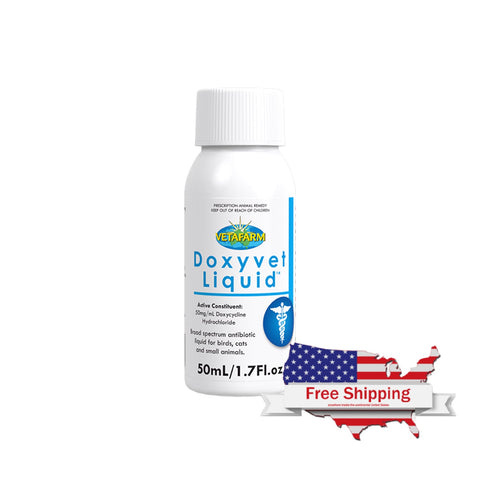
Enrofloxacin vs Doxycycline for Birds
These are two different antibacterial classes.
Enrofloxacin:
Fluoroquinolone antibacterial.
Doxycycline:
Tetracycline-class antibacterial.
They do not have identical bacterial spectra and should not be treated as interchangeable simply because both can appear in respiratory treatment discussions.
Enrofloxacin vs Tylosin
Tylosin belongs to the macrolide family.
It is often discussed in avian respiratory medicine, especially around:
- Mycoplasma-associated disease
- Selected respiratory bacterial problems
Enrofloxacin has a different antibacterial profile.
Enrofloxacin vs Amoxicillin
Amoxicillin belongs to the beta-lactam antibiotic family.
Its mechanism and spectrum differ from enrofloxacin.
The choice should depend on:
- The bacterial organism
- The infection site
- Susceptibility
- The individual bird
Should Enrofloxacin Be Combined With Another Antibiotic?
Do not automatically stack medications because the bird looks very sick.
Combination therapy may sometimes be used professionally, but unnecessary combinations can:
- Complicate treatment
- Increase adverse effects
- Make it harder to identify which medication is helping
Possible Enrofloxacin Side Effects
Veterinary medication references report gastrointestinal effects among the more common possible adverse reactions.
These can include:
- Reduced appetite
- Vomiting
- Diarrhea
Other adverse effects are possible.
Monitor the bird during treatment and report significant new symptoms.
Medication Interactions Matter
Enrofloxacin can interact with other medications or supplements.
If a bird is already receiving:
- Other antibiotics
- Mineral supplements
- Other veterinary medications
review the complete medication list rather than adding another treatment blindly.
Storage of Enrofloxacin Products
Always follow the storage instructions on the exact product.
General good practice includes:
- Keep containers tightly sealed
- Protect from excessive heat
- Protect from strong light
- Keep powder dry
- Do not transfer medication into unidentified containers
Frequently Asked Questions About Enrofloxacin for Birds
What is enrofloxacin?
Enrofloxacin is a fluoroquinolone veterinary antibacterial used against susceptible bacterial infections.
What is Baytril?
Baytril is a familiar veterinary brand associated with the active ingredient enrofloxacin.
Is Baytril the same as enrofloxacin?
Baytril contains enrofloxacin, but Baytril products can come in different strengths and formulations.
What is enrofloxacin used for in birds?
It may be considered for appropriately identified susceptible bacterial infections, including selected respiratory, gastrointestinal, systemic and soft-tissue bacterial disease.
Is enrofloxacin used for pigeon respiratory infections?
Enrofloxacin is frequently discussed in pigeon bacterial respiratory care, but pigeon respiratory signs have multiple possible causes.
Can enrofloxacin treat sneezing in birds?
It can help only when sneezing is caused by a susceptible bacterial condition. Sneezing from dust, fungi, mites or other causes requires different management.
Can enrofloxacin treat tail bobbing?
Tail bobbing is a symptom of increased respiratory effort, not a diagnosis. Enrofloxacin would only be relevant if susceptible bacterial disease were causing the respiratory problem.
Can enrofloxacin treat air-sac mites?
No. Air-sac mites are parasites and require antiparasitic treatment.
Can enrofloxacin treat coccidiosis?
No. Coccidia are protozoan parasites and require a different medication category.
Can enrofloxacin treat pigeon canker?
No. Trichomonas canker is a protozoal disease and is treated with appropriate antiprotozoal medication rather than enrofloxacin.
Can enrofloxacin treat fungal disease?
No. Fungal disease requires an antifungal treatment approach.
What is Baytril 2.5%?
BirdAntibiotic.com Baytril 2.5% is an enrofloxacin oral solution containing 25 mg/mL in a 25 mL bottle.
What is Baytril 10%?
Baytril 10% is a concentrated enrofloxacin oral solution containing 100 mg/mL.
Is Baytril 10% stronger than Baytril 2.5%?
Yes. The 10% liquid contains 100 mg/mL while the 2.5% liquid contains 25 mg/mL.
How much more concentrated is Baytril 10%?
The 10% liquid is four times as concentrated as the 2.5% liquid.
Can I use the same liquid volume for Baytril 2.5% and 10%?
No automatic volume substitution should be made because their concentrations differ fourfold.
Is enrofloxacin 10% the same as 100 mg/mL?
For the current BirdAntibiotic oral liquid products labeled 10%, yes: the concentration is 100 mg/mL.
Is enrofloxacin 2.5% the same as 25 mg/mL?
For the current Baytril 2.5% liquid, yes.
What is Enrofloxacin 10% Powder?
It is a powder-format pet-bird product containing enrofloxacin at a 10% concentration and supplied in a 100 g pouch.
Is 10% powder the same thing as 10% oral liquid?
No. They are different dosage forms and should be used according to the instructions specific to that formulation.
Does BirdAntibiotic carry a 100 mL enrofloxacin bottle?
Yes. A 10% / 100 mg/mL 100 mL oral solution is currently listed.
Does BirdAntibiotic carry a 1-liter enrofloxacin bottle?
Yes. BirdAntibiotic.com currently lists a 1000 mL / 1 liter 10% oral solution containing 100 mg/mL.
Is a 1000 mL bottle stronger than a 100 mL bottle?
No. If both are labeled 10% / 100 mg/mL, the concentration is the same. The larger bottle simply contains more total liquid.
Does BirdAntibiotic sell enrofloxacin tablets?
Yes. Tablet-format enrofloxacin products are currently included in the Baytril/Enrofloxacin bird collection.
Which is better: liquid or powder enrofloxacin?
Neither format is automatically better. The appropriate presentation depends on the individual treatment plan and how the medication is intended to be administered.
Is Baytril an antibiotic?
Yes. Baytril contains the fluoroquinolone antibacterial enrofloxacin.
Is enrofloxacin broad spectrum?
Enrofloxacin has activity against multiple susceptible bacterial groups, but it does not work against every bacterium or every cause of illness.
Can enrofloxacin cause appetite loss?
Reduced appetite is among the gastrointestinal adverse effects reported with enrofloxacin.
Can enrofloxacin cause vomiting or diarrhea?
Gastrointestinal upset including vomiting and diarrhea can occur.
Should enrofloxacin be used when a bird has open-mouth breathing?
Open-mouth breathing at rest is an urgent respiratory sign. Treatment depends on the cause, and a severely dyspneic bird should receive prompt avian veterinary attention rather than being treated from symptoms alone.
Where can I compare BirdAntibiotic enrofloxacin products?
The complete Baytril and Enrofloxacin range is available in the BirdAntibiotic.com Baytril/Enrofloxacin collection.
Explore Bird Antibiotics
Browse our Best Bird Antibiotics collection and explore bird care products organized in one convenient place.
EXPLORE PRODUCTS →How to Compare Enrofloxacin Products Professionally
Step 1 — Confirm enrofloxacin is the active ingredient.
Step 2 — Identify whether the product is 2.5%, 10% or another strength.
Step 3 — For liquids, read the mg/mL concentration.
Step 4 — Identify liquid, powder or tablet format.
Step 5 — Separate concentration from total package size.
Step 6 — Determine whether the bird's condition is actually bacterial.
Step 7 — Consider bacterial culture and susceptibility when disease is severe or recurrent.
Step 8 — Review other medications and supplements.
Step 9 — Follow the instructions for the exact product formulation.
Step 10 — Monitor the bird's response and any adverse effects.
Shop Baytril & Enrofloxacin for Birds
Compare Baytril 2.5%, Baytril 10%, Enrofloxacin 10% Oral Solution, Enrofloxacin Powder and tablet formats in one dedicated collection.
The Most Important Enrofloxacin Rule
Do not identify a medication only by the word:
Baytril.
And do not identify it only by the word:
Enrofloxacin.
Always identify:
ingredient + concentration + formulation + package size.
For example:
Baytril 2.5% — Enrofloxacin 25 mg/mL — Oral Solution — 25 mL.
is completely different in concentration from:
Baytril 10% — Enrofloxacin 100 mg/mL — Oral Solution — 25 mL.
And neither should automatically be treated as equivalent to a powder or tablet product.
Choose enrofloxacin when the condition and bacterial susceptibility make it an appropriate antibacterial—not simply because a bird is sneezing, fluffed or breathing abnormally.
Recommended Products
Products selected to complement this guide.


Shop Related Products
Explore the products featured for this topic.


