 Help & Contact
 Track order




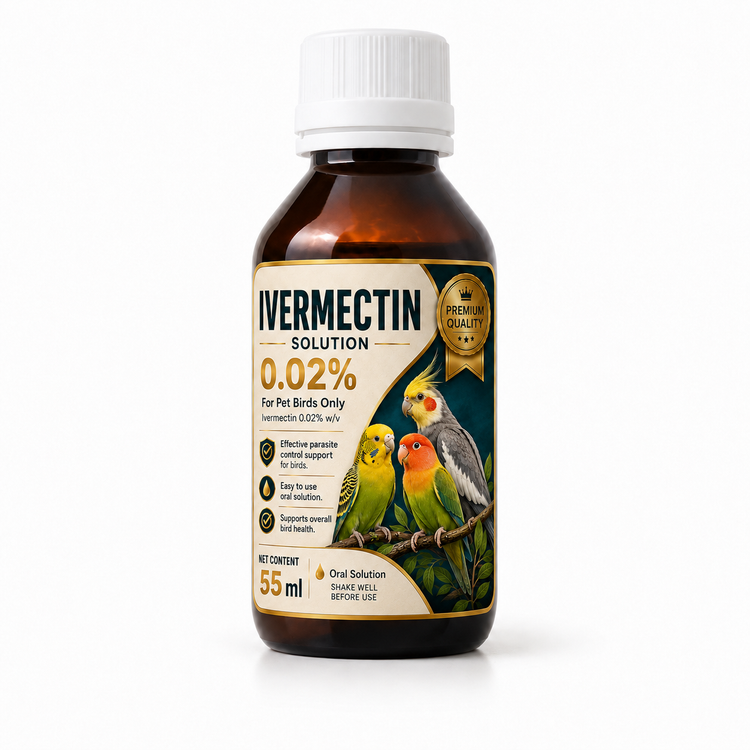
Ivermectin 0.02% Oral Solution for Pet Birds – Avian Parasite & Mite Control Support – 55 mL
Regular price $27.55
In Stock
- FREE SHIPPING ON ORDERS OVER $49
Ivermectin 0.02% Oral Solution for Pet Birds is a liquid avian-care formulation supplied in a convenient 55 mL bottle. Designed specifically for pet and companion birds, it provides a clearly identified 0.02% ivermectin concentration in an easy-to-handle oral solution format for parasite-control programs directed by an avian veterinarian.
Ivermectin is a well-known antiparasitic active ingredient used in veterinary medicine. In avian practice, veterinarians may consider ivermectin for certain internal and external parasites, including selected mites and nematodes, after evaluating the bird and identifying the likely parasite involved.
Ivermectin 0.02% for Birds – Product Overview
| Product Name | Ivermectin 0.02% Solution |
| Active Ingredient | Ivermectin |
| Strength | 0.02% w/v |
| Form | Oral Liquid Solution |
| Net Content | 55 mL |
| Animal Category | Pet & Companion Birds |
| Product Focus | Avian Parasite & Mite Control Support |
What Is Ivermectin for Birds?
Ivermectin is an antiparasitic compound widely recognized in veterinary medicine. In pet-bird practice, ivermectin may be selected by veterinarians for certain parasitic infestations when the parasite involved is considered susceptible to the active ingredient.
Pet birds can encounter both external parasites, such as certain mites, and internal parasites, such as selected nematodes. Correct identification is important because not every feather, skin, respiratory, or digestive problem in a bird is caused by parasites.
Avian Parasite & Mite Control Support
Ivermectin has an established role in avian veterinary medicine for selected parasitic conditions. Veterinary references describe its use for some intestinal nematodes, scaly-face and scaly-leg mites, feather mites, and respiratory air-sac mites in appropriate bird patients. :contentReference[oaicite:1]{index=1}
The appropriate treatment depends on the parasite, bird species, body weight, health status, and veterinary diagnosis. Because similar symptoms may be caused by nutritional, infectious, environmental, or behavioral conditions, parasite treatment should not be selected based only on appearance.
Key Product Features
- Ivermectin 0.02% w/v formulation
- Designed for pet-bird parasite care
- Convenient 55 mL bottle
- Liquid oral solution format
- Relevant to selected internal and external parasite-control programs
- Suitable for companion and ornamental bird-care settings
- Clearly identified concentration for easier product recognition
- Veterinary antiparasitic active ingredient
Ivermectin for Bird Mites
One of the most frequently searched uses of ivermectin in avian care is bird mite control. Different mite species can affect different areas of the bird and may require different management strategies.
Veterinary sources describe ivermectin as one treatment option for selected mite infestations in birds. Environmental cleaning is also important because some parasites can survive in cages, nest boxes, wooden perches, or other parts of the bird's environment. :contentReference[oaicite:2]{index=2}
Scaly Face & Scaly Leg Mites
Scaly face and leg mites are particularly associated with budgerigars, although canaries, finches, and other birds may also be affected. Signs can include flaky or crusty material around the beak, nostrils, face, legs, or toes.
Because these signs can resemble other conditions, veterinary examination can help confirm whether mites are actually present before an antiparasitic treatment is selected. :contentReference[oaicite:3]{index=3}
Air Sac Mites in Birds
Air sac mites are respiratory parasites most often associated with birds such as canaries and Gouldian finches. Heavier infestations may be associated with breathing difficulty, clicking or high-pitched respiratory sounds, sneezing, tail bobbing, or open-mouth breathing.
Veterinary references identify ivermectin among the antiparasitic medicines that may be used in appropriate cases. Respiratory signs can also indicate serious non-parasitic disease, so professional diagnosis is especially important. :contentReference[oaicite:4]{index=4}
Feather & External Mites
Some external parasites live on or around feathers and skin. True feather-mite infestations are less common in many indoor pet birds than owners sometimes assume, while birds housed in outdoor aviaries can have greater exposure to certain mite species.
Feather loss, itching, damaged plumage, or restlessness should therefore be evaluated rather than automatically assumed to be caused by mites. Veterinary references note that other behavioral, husbandry, and systemic conditions are often responsible for feather problems in pet birds. :contentReference[oaicite:5]{index=5}
Internal Parasite Support
Pet birds can also develop certain internal parasites. Veterinary references describe ivermectin as effective against selected nematodes in appropriate avian cases. Diagnosis may involve physical examination and testing such as fecal evaluation. :contentReference[oaicite:6]{index=6}
Not every intestinal parasite responds to the same medication. Tapeworms, protozoa, nematodes, and other parasites can require different treatments, so identifying the organism is an important part of responsible parasite management.
Common Pet-Bird Categories
This product is positioned for pet and companion birds. Common bird-care categories may include:
- Budgerigars and budgies
- Parakeets
- Canaries
- Finches
- Cockatiels
- Lovebirds
- Parrots
- Macaws
- Companion pigeons
- Other ornamental and companion birds
Species can differ substantially in sensitivity and medication requirements. Inclusion in this list does not mean that ivermectin is automatically appropriate for every bird or every parasitic condition.
Why Parasite Diagnosis Matters
Birds with parasites may show signs such as feather damage, crusting, skin changes, respiratory sounds, weight loss, weakness, reduced activity, or digestive changes. However, these signs are not specific to parasites.
An avian veterinarian can evaluate the bird and determine whether parasites are involved and which parasite-control approach is appropriate. This helps avoid unnecessary treatment and reduces the risk of overlooking another medical condition.
Product Specifications
- Product: Ivermectin Solution
- Active Ingredient: Ivermectin
- Strength: 0.02% w/v
- Form: Oral liquid solution
- Bottle Size: 55 mL
- Animal Category: Pet birds
- Product Type: Veterinary antiparasitic solution
- Care Focus: Parasite and mite control support
Environmental Parasite Management
Treating the bird may be only one part of parasite control. Depending on the organism, cages, perches, nesting areas, toys, and other environmental materials may also require thorough cleaning or replacement.
Veterinary guidance is especially valuable where multiple birds share the same enclosure, because some parasites can spread between birds or persist in the surrounding environment.
Storage & Handling
- Keep the product in its original labeled container.
- Close the bottle securely after use.
- Shake well before use when directed by the product label.
- Store according to the instructions provided with the product.
- Protect from unsuitable heat and direct sunlight.
- Keep out of reach of children.
- Do not use beyond the stated expiration date.
Responsible Veterinary Use
For pet-bird veterinary use only. Not for human use. The correct use of ivermectin depends on the bird species, parasite involved, concentration, body weight, health status, and other clinical factors.
Do not apply generalized dosing information from another ivermectin concentration or another animal species. Veterinary ivermectin products can differ substantially in concentration and formulation.
Ivermectin use in food-producing birds can be subject to additional regulatory requirements and may constitute extra-label drug use. This listing is therefore positioned specifically for pet and companion birds, consistent with the product label. :contentReference[oaicite:7]{index=7}
Frequently Asked Questions
What is Ivermectin 0.02% Solution for birds?
It is a liquid pet-bird formulation containing ivermectin 0.02% w/v and presented in a 55 mL bottle.
What is ivermectin used for in birds?
Veterinarians may use ivermectin for selected internal and external parasites in birds, including certain mites and nematodes, depending on diagnosis and species.
Can ivermectin be used for bird mites?
Ivermectin is used in avian veterinary medicine for certain mite infestations. The exact parasite should ideally be identified because different feather, skin, and respiratory problems can look similar.
Can ivermectin be used for scaly face mites?
Veterinary references describe ivermectin among the treatments used for scaly-face and scaly-leg mite infestations in pet birds. :contentReference[oaicite:8]{index=8}
What are air sac mites?
Air sac mites are respiratory parasites found particularly in some canaries and finches. Heavy infestations can interfere with normal breathing and require prompt veterinary evaluation.
Is this product for pet birds?
Yes. The product label identifies it specifically as an ivermectin solution for pet birds.
How large is the bottle?
The bottle contains 55 mL of solution.
Can all bird parasites be treated with ivermectin?
No. Different parasites require different treatments. Veterinary diagnosis is important to determine whether ivermectin is appropriate for the organism involved.
Usually ships within 1 business day to USA & CANADA
Shipping Options:
FREE SHIPPING ON ALL ORDERS- USPS First Class Package : $6.95, 3-5 days (USPS First Class Package)
- FedEx 2Day®: $29.95, 1-Business Days (FedEx)
More Shipping Info:
- Orders placed Monday-Friday before 2pm Central Time usually ship the same day.
- We ship to the USA And Canada only.
Related Products


- $39.50
- $59.99
- $39.50
